
What Is a Project Manager?
A Project Manager (PM) is a professional who leads, plans, executes, monitors, and closes projects while ensuring they meet their objectives, stay on schedule, and remain within budget. According to the Project Management Institute (PMI), a PM is responsible for tasks like:
- Identifying project goals and defining scope
- Planning deliverables, tasks, and schedules
- Allocating and managing resources
- Communicating with stakeholders
- Tracking progress and managing risks
- Ensuring project quality and success Project Management Institute
In essence, a project manager acts as the bridge between a project’s vision and its execution. They coordinate teams, align stakeholders, handle constraints (scope, time, cost, quality), and make sure that the intended value is delivered.
Project management roles exist across industries—technology, construction, marketing, finance, healthcare, and more. While the domain varies, the core function remains: transforming ideas into reality through structured, disciplined management.
What Does a Project Manager Do?
The specific responsibilities of a PM depend on industry, project size, and methodology (waterfall, agile, hybrid). Still, across contexts, there is a consistent set of core duties. Below is a breakdown of major responsibilities:
Planning & Defining Scope
- Work with stakeholders to clarify goals, requirements, deliverables, and constraints
- Define the project scope (what's in, what’s out)
- Create a project plan or roadmap that sequences tasks and milestones
- Establish success criteria and acceptance conditions
Organizing & Resourcing
- Identify required resources (human, financial, technological)
- Assemble and coordinate the project team
- Define roles and responsibilities clearly
- Document dependencies and resource constraints
Monitoring, Controlling & Execution
- Track task progress, key milestones, and ensure on-time completion
- Manage changes, scope creep, or shifts in priorities
- Identify risks and issues early; mitigate proactively
- Oversee budget and expense management
- Ensure deliverables pass quality checks before client acceptance
Stakeholder Management & Communication
- Act as the main liaison between the team, leadership, clients, and external parties
- Provide status updates, reports, dashboards
- Handle expectations, feedback, and conflict resolution
- Escalate issues or changes when needed
Closing & Evaluation
- Ensure all deliverables are completed and accepted
- Facilitate handoff or transition to operations
- Perform post-mortem or lessons-learned sessions
- Capture project metrics, lessons, and best practices for future use
Because a project is a temporary endeavor, a project manager's job spans initiation, planning, execution, monitoring & control, and closure — following the standard PM lifecycle.
Moreover, PMs are expected to maintain balance among the “triple constraint” (or competing constraints) — scope, schedule, and cost — while ensuring quality and stakeholder satisfaction.
Project Manager Salary & Outlook (Based on BLS & Industry Data)
Salary / Earnings (2025 Updated Data)
If you’re wondering how much a project manager makes in 2025, the short answer is: around six figures in the United States — and growing every year.
Project management continues to rank among the most stable and lucrative business careers, with salaries influenced by experience, certifications, and industry type.
Average Project Manager Salary in the U.S. (2025)
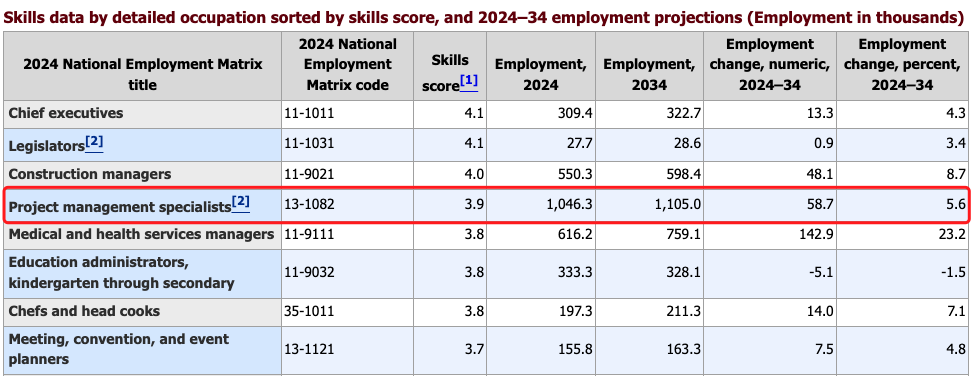
According to the U.S. Bureau of Labor Statistics (BLS) — the most authoritative government source — the median annual wage for Project Management Specialists (SOC 13-1082) was $100,750 as of May 2024.
That’s roughly $48.44 per hour, based on the latest Occupational Employment data from BLS.gov.
| Percentile | Annual Salary | Hourly Wage | Meaning |
|---|---|---|---|
| 10th | ~$59,830 | ~$28.77 | Entry-level or assistant PM roles |
| 25th | ~$76,950 | ~$36.99 | Early-career professionals |
| 50th (Median) | $100,750 | $48.44/hr | National midpoint for experienced PMs |
| 75th | ~$131,660 | ~$63.30 | Senior project managers |
| 90th | ~$165,790 | ~$79.71 | Director-level or technical PMs |
💡 Quick Insight: Even entry-level PMs earn well above the U.S. national median wage of about $48,000 (BLS 2024), making project management an excellent career path for income growth.
Job Growth & Demand Outlook
The career outlook for project management is strong:
- The Bureau of Labor Statistics highlights project management as a high-skill, in-demand competency.
- Many industry forecasts estimate a significant demand increase through 2027 and beyond. For example, some sources project ~33% growth in project management job opportunities by 2027.
- Across sectors (IT, construction, healthcare, consulting), organizations increasingly rely on structured project management to deliver on strategic initiatives, digital transformation, and complex cross-functional programs.
Because projects drive innovation, operational improvements, and business change, project managers are well-positioned as critical enablers of success — especially as companies adopt AI, automation, and hybrid operating models.
How to Become a Project Manager: Step by Step
Education Advice
A strong educational foundation is one of the best ways to start your journey toward becoming a project manager.
Most project managers hold a bachelor’s degree in fields such as Business Administration, Management, Project Management, Computer Science, Information Technology, or Engineering. According to multiple industry education reports, about 68% of project managers have at least a bachelor’s degree, making it the most common entry point into the profession.
Earning a degree in these areas provides valuable knowledge in project planning, leadership, budgeting, risk management, and communication—skills that employers consistently seek when hiring for project management roles.
For best results, choose an accredited university program that offers:
- A curriculum aligned with Project Management Institute (PMI) standards
- Opportunities for hands-on learning, such as capstone projects or internships
- Courses in both technical management and soft skills like communication and leadership
Systematic Learning of PM Skill Sets
To be effective, you’ll need to grow two core skill types:
Technical / Hard Skills You Should Develop
These are skills you can often practice, measure, and refine. Key areas include:
- Project planning & scheduling: Work breakdown structure (WBS), Gantt charts, critical path, dependencies
- Budgeting & cost control: Estimating costs, tracking variance, forecasting
- Risk & change management: Identifying risks, assessing impact, planning contingencies
- Scope & requirements management: Defining scope, handling scope creep, requirement traceability
- Quality assurance & control: Ensuring deliverables meet acceptance criteria, defect tracking
- Methodologies & frameworks: Waterfall, Agile (Scrum, Kanban), hybrid models
- Tool & software proficiency: Jira, Asana, MS Project, Trello—and modern AI-augmented tools
Soft / Interpersonal Skills You Need
These are often what differentiate a “good” PM from a “great” one:
- Clear, concise communication & stakeholder management
- Leadership & team motivation
- Conflict resolution, negotiation & influence
- Critical thinking & decision making under uncertainty
- Adaptability & resilience when things deviate
- Time management & priority setting
Gaining Relevant Experience (Even Without a PM Title)
One of the biggest obstacles is breaking in without prior project management experience. Here are strategies:
- Take on small projects or side initiatives: Volunteer to manage parts of a project in your current job (e.g. coordinate a team, lead an event). Many “accidental PMs” start by organizing tasks, communication, or logistics.
- Offer help internally: Ask your manager or team: “I’d like to help coordinate this project — could I assist with scheduling, tracking, or stakeholder updates?”
- Use freelancing, internships, or pro bono work: Small digital projects (websites, marketing campaigns) or nonprofit initiatives can give real exposure.
- Step into supporting roles: Titles like Project Coordinator, Project Analyst, Operations Assistant, Scrum Master (junior) are lower-barrier roles that let you observe and assist project management tasks. Indeed calls these “entry-level project management positions” in its guidance.
- Document & present your work: Even if your title isn’t “Project Manager,” frame what you did as PM-relevant: coordinated tasks, resolved issues, tracked timelines, engaged stakeholders. Use this in your resume and portfolio.
With persistence, the volume of small projects you manage accumulates into a credible track record.
Interview Preparation: PM Interview Questions & Strong Responses
When interviewing for project management roles, hiring managers often probe both technical knowledge and behavioral judgment. Below are common interview questions and how to approach answering them.
Common PM Interview Questions
From Indeed, Teamwork, Coursera and other sources, here are sample PM interview questions:
- “How do you define project success? What metrics do you use?”
- “Tell me about a time when a project faced a major challenge. How did you respond?”
- “How do you manage scope changes mid-project?”
- “Describe a project you’ve led (or been part of): from planning through delivery.”
- “How do you identify & mitigate risks?”
- “How do you communicate with stakeholders and handle conflicting priorities?”
- “Which project management tools and methodologies are you comfortable with?”
- “Describe a conflict within a team you were on. How did you resolve it?”
- “Tell me about a project that failed or didn’t go as planned. What did you learn?”
- “How do you prioritize tasks and resources when multiple deadlines collide?”
How to Structure Strong Answers (STAR / CAR Format)
- Situation / Context: Set up the background
- Task: Explain your role or objective
- Action: Describe what you specifically did
- Result: Share measurable outcome or key learning
Even if your project involvement was minor, framing it well shows your thinking and potential.
Also be prepared to ask your own smart questions (e.g. about governance, KPIs, escalation paths) — that shows you understand PM as a discipline.
Bonus Factors to Accelerate Your Path to PM
To stand out and fast-track your journey, consider these value-add elements:
Certifications
- CAPM® (Certified Associate in Project Management) — entry-level PMI certificate.
- PMP® (Project Management Professional) — gold standard for experienced PMs.
- Scrum Master / Agile Certifications (PSM, CSM, etc.)
- PRINCE2 Practitioner / Foundation (especially in certain geographies)
Domain Knowledge / Specialization : Focus on a particular industry (tech, healthcare, construction) and learn its jargon, challenges, and regulations. This helps you bridge the gap between general PM skills and domain-specific expectations.
Technical & Data Skills: Familiarity with data analytics, dashboards, AI-powered tools, automation, process mining—these can differentiate you in the field. AI-enhanced project tools are becoming more common.
Networking & Mentorship: Join PMI chapters, local PM meetups, LinkedIn groups, or PM communities (e.g. PMHub) for guidance, job leads, and insights.
Thought Leadership / Content: Creation Blogging, speaking, or publishing short case studies or project retrospectives shows you’re engaged with the craft of project management.
Soft Skills Mastery: Strong written/verbal communication, emotional intelligence, negotiation, and leadership often become decision criteria beyond technical skills.